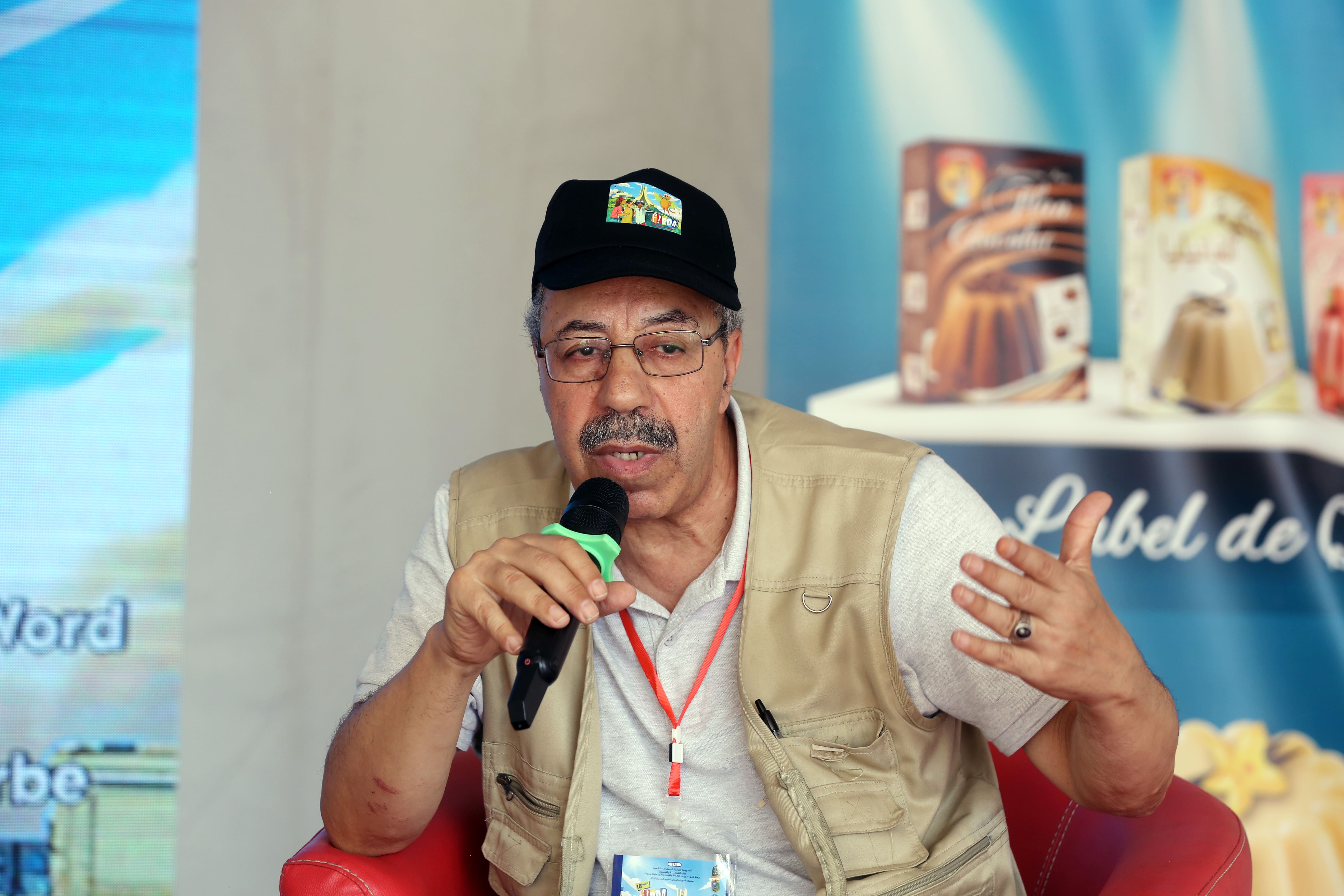
The figure of Takfarinas, the Numidian hero who led the resistance against Rome, was at the heart of a meeting held on Saturday, October 3, 2026, as part of the Algiers International Comics Festival (FIBDA). Comic book artist Benyoucef Abbas Kebir presented his latest album dedicated to this historical figure, discussing the origins of a project he had been working on for several years, his documentary research and the challenges involved in adapting the story into a comic book.
The author of more than a dozen albums and a specialist in historical comics, Benyoucef Abbas Kebir now has fourteen albums to his name, including Takfarinas, héros numide. Invited to present his latest publication, he explained that his choice was driven by a desire to explore periods of Algerian history that have received little attention in comics. "Our history is rich in events," he said, referring to the different historical periods Algeria has experienced. He therefore turned to Antiquity, a period marked in particular by the emergence of the first Berber kingdoms and the Roman presence. He chose Takfarinas, a figure whose biography, he noted, remains little known to the general public and has rarely been addressed in comics.
The project, however, dates back several decades. The author revealed that his work on Takfarinas began in 1993 and that he spent around ten years preparing it. At the time, he submitted the project to the newspaper Liberté, which paid him for it but ultimately did not publish it.
To build his narrative, Benyoucef Abbas Kebir drew on four or five books dealing with the historical figure and the period. He explained that he compared the different sources in order to identify their common elements, particularly those concerning Takfarinas' birth, his main battles and his death. He described this approach as essential for a work aimed at making history accessible to young readers. "We must avoid grey areas and ambiguities," he explained, stressing that young readers should be able to clearly follow the character's journey, from birth to death. This desire to make history accessible is one of the guiding principles of his work.
In the album, Takfarinas is portrayed as having been born in Thagaste, present-day Souk Ahras, in 7 BC. From a young age, he trained in warfare, particularly in archery and horsemanship. He was subsequently enlisted in the Roman army, as were many indigenous people at the time, allowing him to acquire military experience.
The situation changed when he became aware of the policy pursued by the Romans towards the local populations. According to the story presented by the author, Takfarinas then deserted the Roman army and went to the region of Auzia, known as Aumale during the colonial period and corresponding today to Sour El Ghozlane, where he began organizing the resistance with a group of Numidians.
He gradually built an army and trained young fighters. The first confrontations with the Roman legions resulted in several defeats, but Takfarinas withdrew each time to reorganize his forces and continue the resistance. Faced with a better-equipped Roman army, he also developed other forms of action.
Takfarinas, the Strategist
It is particularly around economic resistance that the author built part of his narrative. Takfarinas is said to have ordered the indigenous populations to stop selling their wheat to the Romans. Drawing on this historical element, the author developed a fictional sequence in which Takfarinas and his men disguise themselves as wheat merchants in order to enter a fortress and free prisoners.
This choice was also dictated by an editorial constraint. The album is 32 pages long, a format that requires the author to make choices when dealing with a particularly rich biography. Around twenty pages are devoted directly to Takfarinas' life, while the album opens with an overview of the history of North Africa, the Phoenicians and the main Berber kings, including Massinissa, Jugurtha and Juba.
To complete the narrative, the author therefore incorporated this fictional story built around a historical background. This section allowed him to add several pages while remaining within the album's broader historical framework.
The comic book's journey has also been marked by recognition through a support programme. The project won third prize for Best Project the previous year. It was subsequently submitted by its publisher, Papyrus Editions, as part of the Ministry of Culture's support programme for authors and publishers. The project was ultimately selected for publication and distribution to the general public.
During the meeting, the author also looked back on his career in historical comics. His work has focused in particular on events and figures from Algerian history, including October 17, 1961, the history of Algeria from its origins to November 1954, Emir Abdelkader, Ben M'hidi, Petit Omar and diplomacy.
A French-language version of the album dedicated to Takfarinas is due to be published soon. As for his upcoming projects, Benyoucef Abbas Kebir remains committed to the historical genre, while moving to a different period. He is currently working on the history of his hometown, Miliana, which he also plans to tell through comics. He has also submitted Tragédie sur Seine, the third volume devoted to the massacres of October 17, 1961, to Papyrus Editions.
The FIBDA meeting also gave the author an opportunity to reflect on how research methods have evolved. When he was working on Takfarinas in the 1990s, accessing documentation required travelling to libraries and carrying out extensive research to gather the necessary references. Today, he believes, the Internet and new technological tools have profoundly transformed documentary research.
Yet despite this abundance of sources, he maintains that the process remains one of selection and synthesis. For an album aimed at young readers, he believes it is necessary to retain the key stages of the biography and present them clearly, in order to introduce readers to a historical figure who remains relatively unknown.